
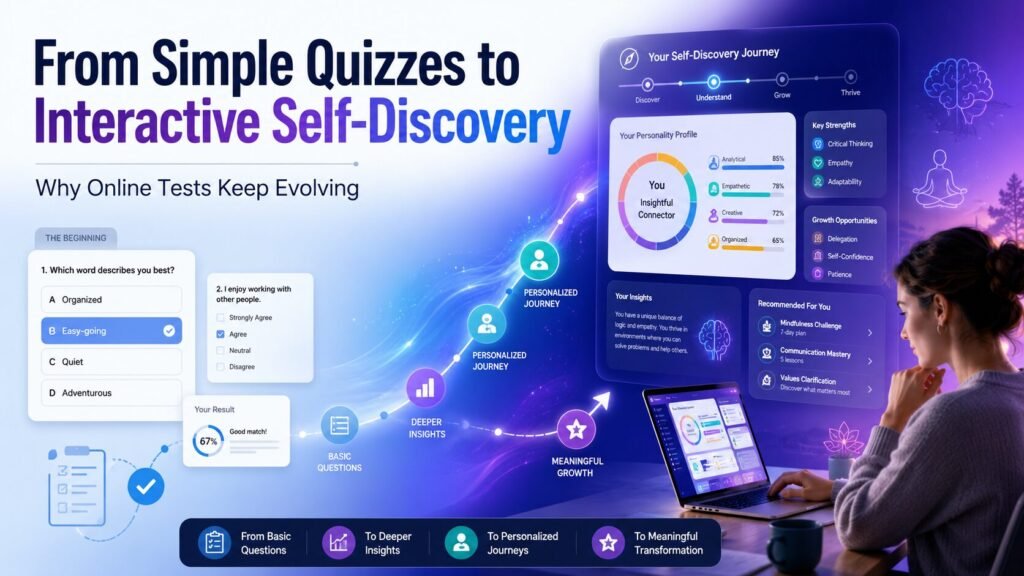

The internet has changed the way people consume information, but it has also changed the way they interact with it.
A traditional article asks readers to sit back and absorb information. A video asks them to watch. A social post may ask for a reaction. Interactive content does something different: it asks the user to make a choice.
That simple difference has helped quizzes and online tests remain popular through several generations of the web.
What began with basic personality quizzes and novelty questionnaires has expanded into a much broader category. People can now find interactive experiences covering personality, relationships, careers, preferences, habits, general knowledge and self-discovery.
The format continues to work because it turns an ordinary browsing session into something personal.
Instead of simply asking, “What does this website have to tell me?” a test asks, “What happens when I answer these questions?”
That change gives users a reason to participate.
The Early Appeal of Online Quizzes
Some of the earliest popular online quizzes were deliberately simple.
They might ask a handful of questions and then assign a playful result. The subjects were often lighthearted: favorite foods, fictional characters, personality types or hypothetical situations.
The technology was not particularly sophisticated.
The attraction came from the format itself.
A person could answer questions, receive a result and compare it with friends. The experience took only a few minutes, but it created something worth talking about.
This made quizzes particularly effective for sharing.
Someone who received an unexpected result had an easy reason to tell someone else about it.
The quiz therefore became more than a page on a website. It became a small social experience.
Interactive Content Changes the Role of the Reader
The biggest difference between a conventional article and an interactive test is participation.
When reading an article, the reader generally follows the author’s structure.
With a test, the user’s choices influence what happens next.
That creates a sense of involvement.
Even when the final result is generated from a relatively simple scoring system, the user feels connected to it because they supplied the answers.
This psychological difference can make interactive content more memorable.
A person may forget an article they read five minutes ago. They may remember a quiz result because it felt like something they personally produced.
The result is attached to their choices.
Why People Like Getting Personalized Results
Personalization is one of the strongest features of interactive content.
People naturally pay more attention when information appears to be relevant to them.
A general article might explain several personality traits.
A quiz can say, in effect, “Based on your answers, this is the result that fits your responses.”
That creates a stronger sense of relevance.
The same principle works across many categories.
A career quiz can organize answers around possible preferences.
A relationship quiz can highlight differences in communication or habits.
A personality test can group responses into a particular profile.
A self-discovery test can encourage someone to consider patterns in their choices.
The result does not have to be scientifically definitive to feel personally meaningful.
The Growth of Personality Tests
Personality tests have become one of the most recognizable forms of interactive content.
Their popularity comes partly from an enduring human interest: understanding ourselves.
People are curious about whether they are introverted or outgoing, analytical or intuitive, cautious or spontaneous, structured or flexible.
An online personality test turns those broad questions into a sequence of simple decisions.
The user does not have to understand psychological theory to participate.
They simply respond to situations and preferences.
The final result then provides a framework for reflection.
Some tests are created mainly for entertainment, while others are based on more established concepts. Users should understand the difference rather than treating every online result as a formal psychological assessment.
Even a lighthearted test can still be interesting when its purpose is clear.
Relationship Tests Add a Social Dimension
Another major category involves relationships and compatibility.
These tests ask questions that encourage people to compare preferences, communication habits and reactions to everyday situations.
The experience becomes particularly engaging when two people complete the same test.
Instead of simply reading a result, they can compare their answers.
That creates a conversation.
One person might discover that they approach disagreements differently from their partner. Friends may realize that they have surprisingly different ideas about spending free time. Two people may discover several unexpected similarities.
The quiz provides the questions, but the interaction between the participants creates much of the value.
Career Quizzes Turn Questions Into Exploration
Career-related tests represent another evolution of the format.
Choosing a career can be overwhelming because there are so many factors to consider.
An interactive questionnaire can make the process feel more approachable by breaking broad questions into smaller ones.
What kind of tasks do you enjoy?
Do you prefer working independently or with others?
How important is creativity?
Would you rather solve practical problems or work with ideas?
Do you prefer predictable routines or changing environments?
The resulting suggestions should not be treated as professional career advice or a definitive answer.
However, they can help someone identify areas worth researching.
A student who receives a result pointing toward creative fields might begin exploring careers they had not previously considered.
The test becomes a starting point for research rather than the final decision.
Self-Discovery Tests Encourage Reflection
Self-discovery is broader than personality.
People can use interactive questions to think about habits, preferences, priorities and everyday choices.
A test might ask how someone responds to uncertainty, how they spend free time or what they value when making decisions.
The questions can be more interesting than the final label.
Sometimes people discover that they have never consciously considered why they behave a certain way.
For example, a question about planning could make someone realize how strongly they prefer certainty. Another question about social situations might reveal that they enjoy meeting people but need time alone afterward.
The test does not necessarily uncover something hidden.
It simply gives the person an opportunity to notice it.
Why Interactive Content Often Holds Attention Longer
A passive page can be skimmed.
An interactive test requires a sequence of actions.
The user has to read the question, choose an answer and continue.
That creates a small commitment.
Once someone has answered five questions, they are more likely to complete the remaining five because they want to see the result.
This is one reason interactive formats can generate strong engagement.
There is an unfinished loop:
I have started this, so I want to know how it ends.
That anticipation keeps people involved.
The same principle appears in many digital experiences, but quizzes use it particularly well because the outcome is connected directly to the user’s choices.
Interactive Content Creates Natural Sharing Opportunities
A good result can also encourage sharing.
Someone may want to show friends what they received.
A surprising outcome may prompt a discussion.
A funny result may become a social post.
A useful career result may be sent to someone considering a new direction.
This makes interactive content naturally suited to social environments.
Unlike a conventional article, a quiz result often feels like a statement about the person who completed it.
That makes it more personal and therefore more likely to become part of a conversation.
The Questions Matter More Than They Seem
The quality of an interactive experience depends heavily on its questions.
Poorly written questions can make a test feel repetitive or predictable.
Strong questions can make users stop and think.
Consider the difference between:
“Do you like socializing?”
and:
“After a busy week, would you rather spend your weekend at a large gathering or have a quiet evening with a few close friends?”
The second question gives the user a specific situation.
It asks them to imagine behavior rather than simply select an abstract label.
Well-designed questions also avoid making every answer obviously “good” or “bad.”
When users feel that there is no correct answer, they are more likely to respond honestly.
Why There Is No Need for Every Test to Be Serious
Interactive content can serve different purposes.
Some tests can encourage genuine reflection.
Others can simply be entertaining.
A playful quiz about fictional characters can be just as successful at attracting participation as a more thoughtful self-discovery test.
The key is setting the right expectation.
Users should understand whether they are taking something designed for amusement, informal reflection or a more structured assessment.
Not every quiz needs to solve a problem.
Sometimes people simply want something fun to do for five minutes.
That low barrier to entry is part of the format’s enduring appeal.
The Social Potential of Interactive Content
Quizzes become particularly interesting when they are placed inside a social environment.
A standalone test can provide a result.
A social platform can provide somewhere to discuss it.
Someone might complete a personality quiz and then look for other users who received a similar result.
Another person might share an unexpected outcome and ask whether others agree.
A group of friends could compare their answers.
The interactive feature becomes a bridge into conversation.
This is one reason quizzes can fit naturally into broader social platforms rather than existing only as isolated entertainment pages.
Conflingo and the Role of Interactive Tests
Conflingo includes a collection of free online tests and quizzes as one of the additional interactive features available to users.
The distinction is important because Conflingo is a broader social media platform rather than a dedicated quiz website.
Its central experience revolves around conversations, opinions, shared interests and interaction between users. Interactive tests are one way users can engage with content within that wider environment.
This gives a test a different context from a standalone quiz site.
Someone may complete a test because they are curious about the result, then continue exploring other parts of the platform, participate in conversations or discover other people.
The test is therefore one component of a larger social experience.
Why People Compare Results With Friends
Comparison adds another layer of engagement.
A person can take a test privately, but seeing someone else’s result creates context.
Two friends may receive completely different outcomes from the same questions.
A couple may discover that their answers are surprisingly similar.
A group may debate whether a particular result actually matches someone’s personality.
The comparison can even reveal where people interpret the same question differently.
That makes the experience more social than simply reading a description.
It gives people a shared activity and a reason to talk.
Interactive Tests Can Make Abstract Ideas Easier to Explore
Some subjects are difficult to approach through a long explanation.
Personality, preferences and decision-making are abstract concepts.
A series of questions can make them easier to explore.
Instead of reading a definition of a particular behavior, the user encounters situations and chooses what they would actually do.
This changes the experience from learning a definition to considering a personal example.
The format can therefore make complicated ideas feel more accessible.
It does not necessarily make the resulting conclusion more accurate, but it can make the subject easier to think about.
The Importance of Taking Results in Context
Interactive tests are engaging precisely because they simplify complex subjects.
That is also their limitation.
A person’s personality cannot be completely described through a handful of questions.
A career choice cannot be determined by a short quiz.
A relationship cannot be reduced to a compatibility score.
Human behavior depends on circumstances, experiences, values and countless other factors.
For that reason, online tests are best used as prompts for exploration.
A result can suggest something worth thinking about.
It can introduce a new topic.
It can encourage a conversation.
But it should not replace professional advice or serious research when those are genuinely needed.
The Future of Interactive Online Experiences
Interactive content is likely to become more sophisticated as websites continue experimenting with personalization.
Future tests may adapt questions based on previous answers. Results may become more detailed. Users may be able to compare outcomes with larger communities or explore related content based on their responses.
Yet the fundamental appeal will remain surprisingly simple.
People like answering questions.
They like seeing what their answers produce.
They like comparing results.
And they like talking about what they discover.
Technology can make the experience more polished, but it does not need to change the basic formula.
Why Quizzes Continue to Work
The enduring popularity of quizzes is not difficult to understand when the pieces are considered together.
They are accessible.
They are interactive.
They provide immediate feedback.
They can be personalized.
They create curiosity.
They encourage comparison.
They can be educational or entertaining.
Most importantly, they give users an active role.
In a crowded online environment where much of the experience involves scrolling past content, simply asking people to make choices can feel surprisingly engaging.
Interactive Content Is About More Than a Score
The final score or category is often treated as the destination, but it may actually be the least interesting part.
The real experience can happen before and after the result.
The questions encourage reflection.
The answers reveal preferences.
The result provides a talking point.
The comparison creates social interaction.
The discussion adds context.
This turns a short quiz into a small journey rather than a single webpage.
That is why interactive content continues to fit naturally into the modern internet.
Final Thoughts
Online quizzes have evolved considerably from the simple personality questionnaires that helped establish the format.
Today, interactive experiences can explore personality, relationships, careers, preferences, habits and self-discovery. Some are serious enough to encourage thoughtful reflection, while others exist primarily to entertain.
Their common strength is participation.
Instead of simply reading what someone else has written, users make choices and see how those choices shape the experience.
That personal involvement helps explain why free online tests and quizzes continue to attract attention.
Conflingo’s collection of interactive tests is one example of how this format can exist within a broader social media platform. The tests are not the platform’s main purpose; they sit alongside conversations, user interaction, shared interests and other social features.
As online experiences become more interactive, the basic appeal of the quiz is likely to remain.
People will keep asking questions.
They will keep answering them.
And, perhaps most importantly, they will keep wanting to see what their answers say.